

Xiaomi Poco F1 Review: Flagship of the Masses!
Xiaomi has perfected the fine art of pleasantly surprising its fans and followers, and it has done so unveiling smashing smartphones with striking specs at unexpected prices. This strategy has also played a major function in the growth and success that Xiaomi has achieved in India. Just this time around, the company has pleasantly surprised everyone by launching a power-packed smartphone for a totally unexpected price. The Poco F1 by Xiaomi is a stunner of a smartphone that comes with a rich and vibrant specs sail and my jaw however hurts from hanging loosely after first learning well-nigh the price.
The Poco F1 not only puts a mouth-watering platter of supreme capabilities, it does this in a non-flamboyant manner. At the starting price of only Rs 20,999 (on Flipkart), the Poco F1 not just shakes up the market of flagships and flagship killers but is also capable of bringing about a prototype shift in our understanding of the word, "flagship". As well smashing internals, it does endeavor to lean into the world of premium smartphone and scores well for trying.
And, there's a lot more to know well-nigh the smartphone, so let me start by telling you about the specifications of the Poco F1.
Poco F1 Specifications
Poco F1 comes with some robust specification on paper and earlier we showtime excavation into the features and performance, allow me tell yous near the hardware that this smartphone is crammed with.
| Brandish | 6.18 inch, FullHD+ (1080 x 2246 pixels) IPS LCD |
| Memory | 6/8 GB RAM |
| Storage | 64/128/256GB ROM + Hybrid MicroSD slot, upward to 256 GB |
| Processor | Qualcomm Snapdragon 845, Octa-Core (4*two.8 GHz Kryo 385 Gilt & four*1.viii GHz Kryo 385 Silver) with Adreno 630 |
| Camera | 12MP f/one.9 + 5MP f/two.0, LED Flash, 4K & Slo-mo Support, AI |
| Front end | twenty MP f/two.0, AI Portrait Way |
| OS+UI | Android 8.1 + MIUI for POCO |
| Battery | 4,000mAh with Qualcomm's Quick Charge 3.0 |
| Sensor | Fingerprint sensor, IR Confront Unlock, accelerometer, gyroscope, proximity sensor, compass |
| Bluetooth | v.0 with AptX |
| WiFi | Wi-Fi 802.11 a/b/g/n/air-conditioning, dual-ring |
Box Contents
Unlike the fanciful Poco F1, its box packaging is very plain and draped in the characteristic yellowish+black colour scheme, which has long been the universal colour scheme of muscle cars and might also remind y'all of Bumblebee. Cipher special, though, and in the basic packaging you get the following things:
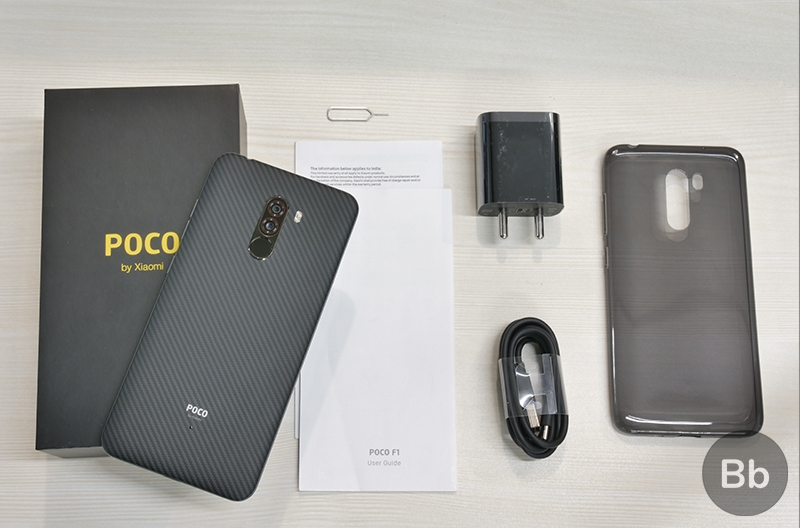
- Poco F1 handset
- USB-C cable
- Poco 18W Quick Charger
- SIM ejector
- TPU protective case
- User manual and warranty guide
Design and Build
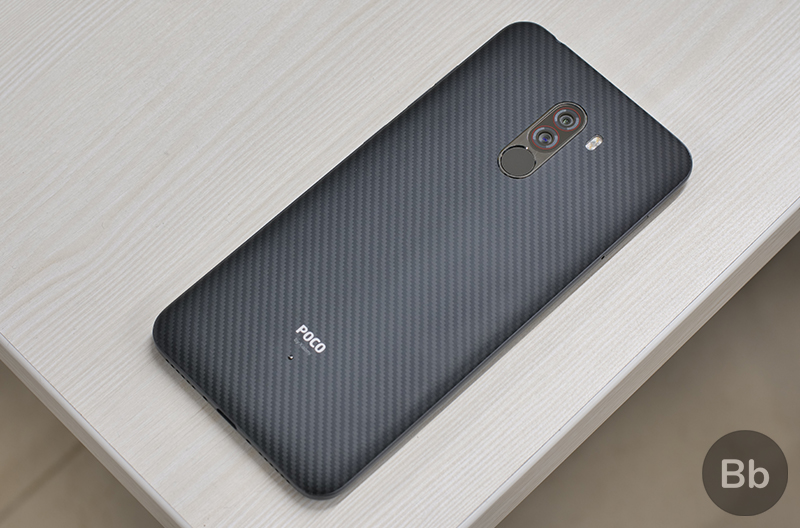
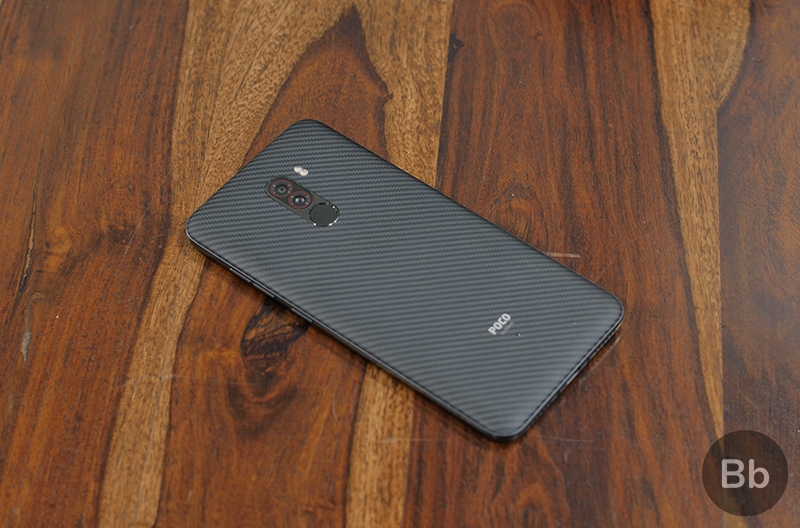
With the emphasis on durability and functioning, Poco F1 is outfitted with a evidently polycarbonate back. The choice of this limbo pattern, as per the company, is a voluntary decision which directs the focus to other features including a adept camera, besides powerful specifications. The band covering the edges appears to be made out of brushed metal just that too is fabricated of plastic.
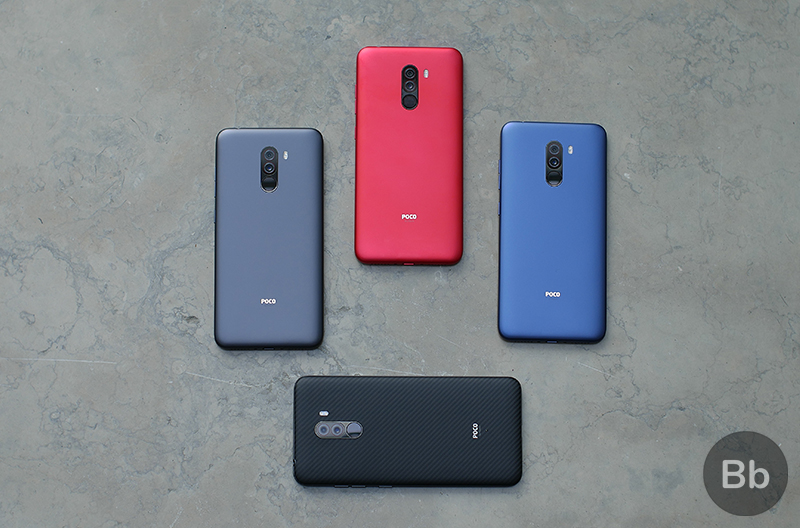
If y'all're all for looks, you tin spend Rs 1,000 over the top variant and cull the "armoured edition" with three layers of Kevlar, which should hoist your spirits and is likely to make the Poco F1 announced slightly premium. Separate volume up and down buttons and the power button are placed forth the right edge of the F1 and the main speaker and the USB-C port lie at the lesser. The buttons placement is convenient and the gap between book and power controls makes it easy to differentiate between buttons. Had the power button been textured it would accept fabricated it more usable. The summit of the Poco F1 carries a headphone jack while the Hybrid SIM tray is placed at the top left of the smartphone.
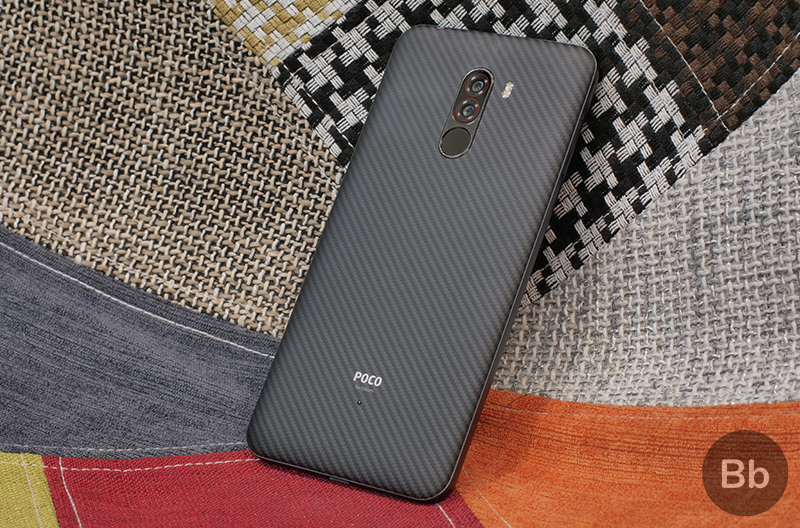
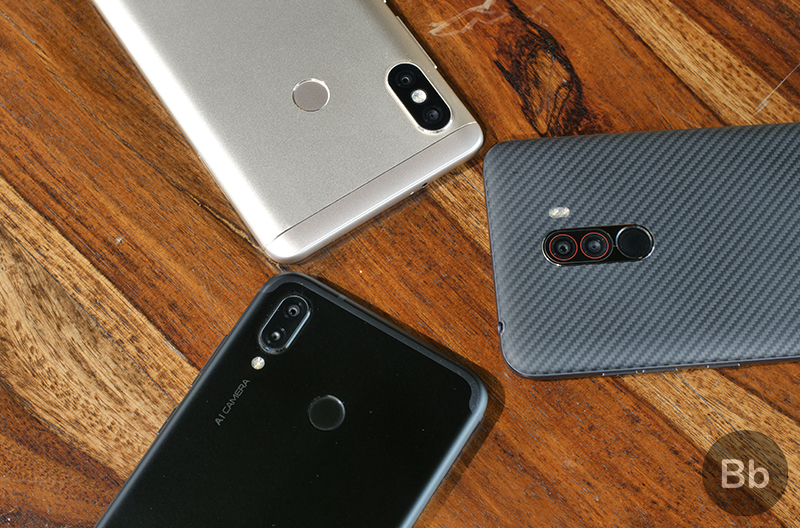
The simplistic structure invokes a feeling of residuum and zen which is maintained when you take a look at the cameras. The dual camera setup, every bit well as the circular fingerprint scanner, is aligned along the eye line and gladly there's no camera bump. The design represents Pocophone's sense of originality and is non congruent with its standard philosophy of blatantly aping the iPhone. This is probably because Xiaomi has launched the smartphone in more than than fifty markets across the globe and design will play a key role in the brand's identity.
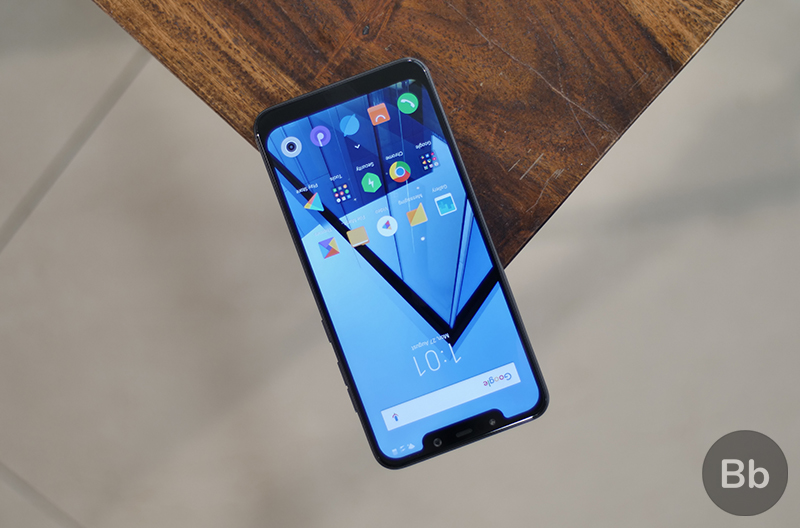
On the forepart, yous get a 6.xviii-inch LCD brandish with a notch on acme of it. The Poco F1 features IR face sensors placed up tiptop. While the selection of LCD over AMOLED is evidently considering of the super-competitive price, it too adds to the overall thickness of the smartphone. The chamfering of edges too cuts down on the ease of handling compared to Mi 8 which comes with an AMOLED display. However, that tin be cured with a back cover such as the ane arranged in the bundle. Lastly, there'south a tiny notification LED intersecting the bottom edge.
Despite the polycarbonate body, in that location isn't much flex and the Poco F1 is not probable to fall prey to a bend-gate anytime soon. Nor will the back shatter if you drop the phone and it feels sturdy enough to handle gentle drops well – although I haven't had the courage to drop it. Lastly, features like NFC, Wireless Charging, whatsoever sort of waterproofing are absent merely those features are not fifty-fifty expected in this toll range.
Overall, I am convinced that the visitor's choice of polycarbonate over glass or metal does not hamper the durability of the Poco F1, the overall build feels solid and sturdy, even if non very premium.
Display
Coming the brandish on the Poco F1, it uses a 6.18-inch LCD brandish which is sufficiently bright and offers good colors. Xiaomi claims that the display supports 84% of the NTSC colour gamut and gets as bright as 500 nits. I tin can ostend that the brandish is easily readable even under directly sunlight. It is protected nether Gorilla Glass 3, which is another instance of cost-cutting considering the 6th gen is already available.
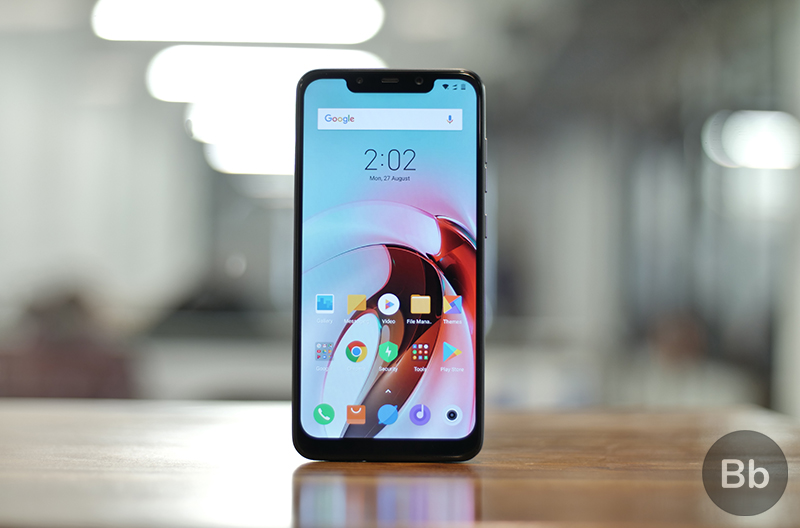
But don't accept me wrong – the brandish gets amply brilliant and has a very vivid color scheme. Like virtually other Xiaomi devices, y'all also get the power to optimize its color temperature every bit per your preference. Like other LCDs, colors appear slightly washed out when the display is looked at from sharp angles, but otherwise, information technology does non disappoint in any way. The colors are well-saturated and would not affect your viewing experience except when looking from those awkward angles.
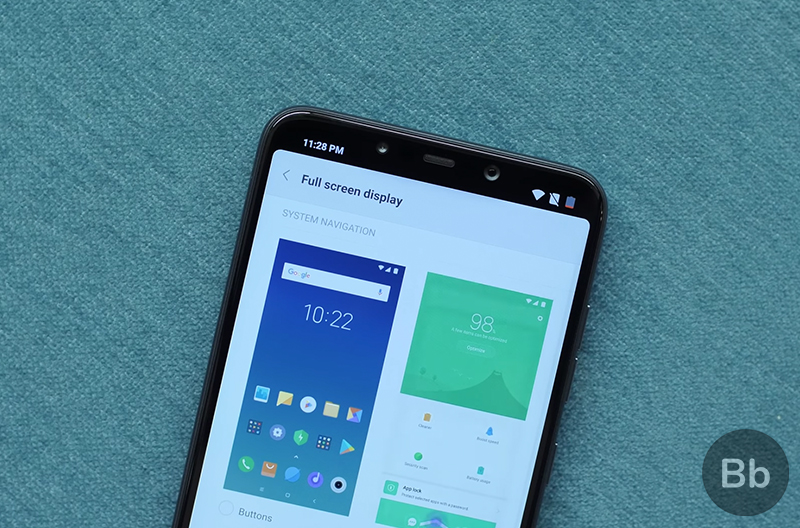
If you're not a big fan of the notch, yous tin can plow information technology off. Just I personally prefer keeping information technology on simply because I have come to like it and enjoy the extra real-estate that it brings to the display. However, in social club to place the infrared confront unlocking equipment, Xiaomi has stolen space from the display and the area around the notch is mostly occupied by battery and signal status and the clock – leaving no room for notification badges or whatever other indicator.
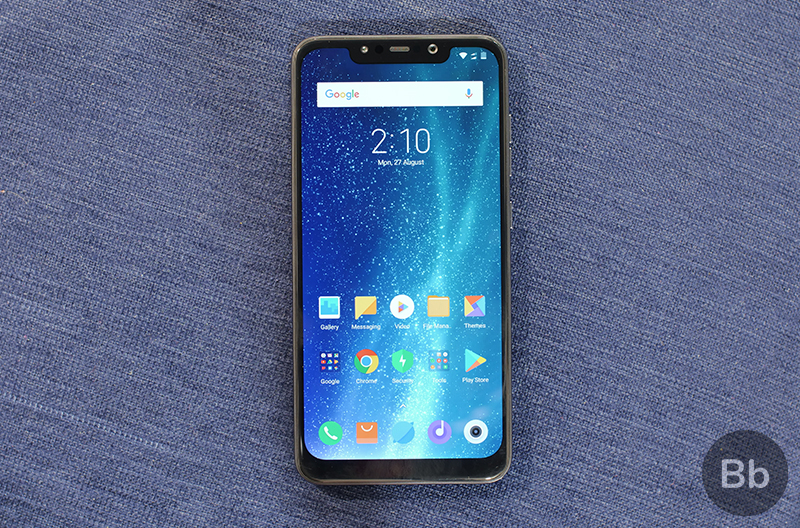
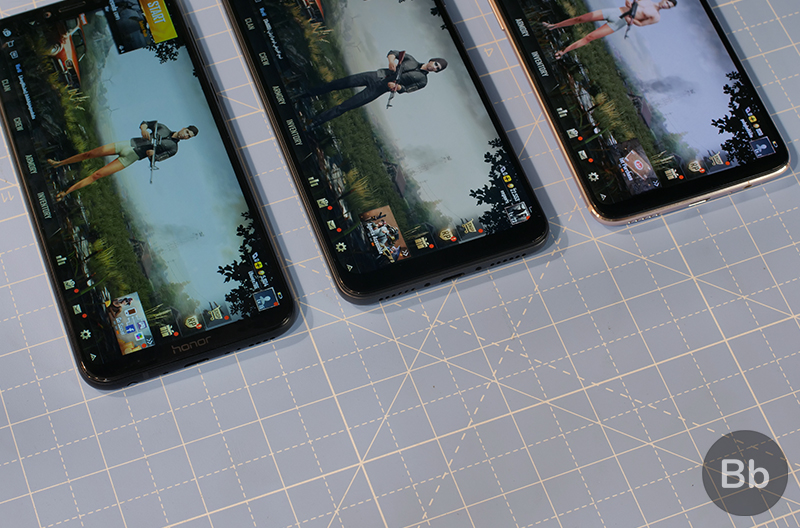
The lower corners of the display are too circular for my liking and I'm totally not into curves of this kind. These corners obstruct viewing of items on the screen and information technology feels like the cover glass and not the screen itself is curved. While the shortcoming does not impact the performance mostly, it is poorly optimized for games and I honestly despise this aspect nigh the Poco F1.
Overall, I discover the Poco F1's display sufficiently brilliant and detailed while the colors are pretty accurate. I just wish that Pocophone had spent more time and endeavor in optimizing the lower rounded corners with at least popular apps like PUBG.
Functioning
With the all the (literally) cut corners aside, the Poco F1 is genuinely a superb performer. The onboard Snapdragon 845 and up to 8GB of RAM unleash the creature behind an unsuspecting facade. Nosotros've seen this chipset rending blazing fast functioning on the likes of OnePlus 6, Xiaomi Mi 8, and Vivo NEX. Both – on newspaper and in real-life – the Snapdragon 845 is the fastest processor but does that ensure unbeatable functioning on the Poco F1?
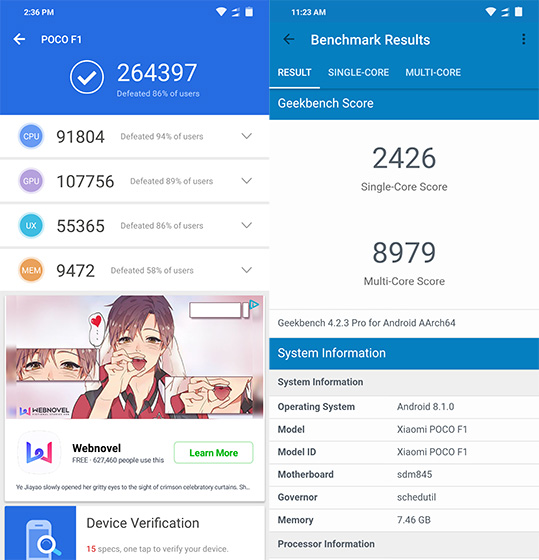
Well to an extent, yeah. In terms of AnTuTu criterion scores, the Poco F1 falls brusque of the Samsung Galaxy S9+, Asus Zenfone 5Z, and even the OnePlus 6 by a small margin. As per Geekbench results, all the 3 affordable Snapdragon 845 smartphones have a shut castor.
Notation:Nosotros're using the 8GB variant of the Poco F1 and the functioning of the 6GB version is probable to be slightly below this variant.
In existent-world usage, the Poco F1 refutes critics by putting up completely lag-free performance and no shuttering at all. In my week-long usage of the Poco F1, I have not encountered whatever issue in day-to-day tasks except for inaccurate support for the notch.
In terms of security, the Poco F1 comes with IR face up unlocking beside the regular fingerprint and the mechanism is pretty authentic, fast, and fairly reliable.

-
Gaming
The gaming performance on the Poco F1 is just amazing and anyone unaware of its prowess tin can hands mistake information technology for a much expensive smartphone. I accept been gaming extensively on the smartphone with titles such every bit PUBG Mobile, Mortal Kombat, Human foot 2018, Shadowgun Legends, and Asphalt 9, and take never observed even a split second of lag.
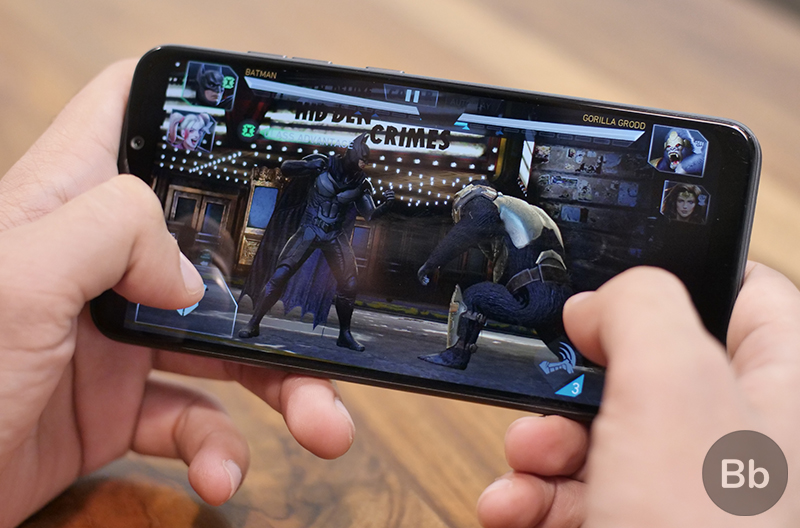
Gameplay is really smooth and incredibly charming. I, nonetheless, did not savor the fact that the screen crops out essential buttons placed along the lower corners. If you tin can forgive the Poco F1 but aside from this drawback, I've loved every moment of gaming on this.
I just wish the Pocophone had taken the effort of calculation a Gaming style and so that the resources could exist utilized fifty-fifty more than properly, merely hopefully that should come in future updates.
-
LiquidCool Technology
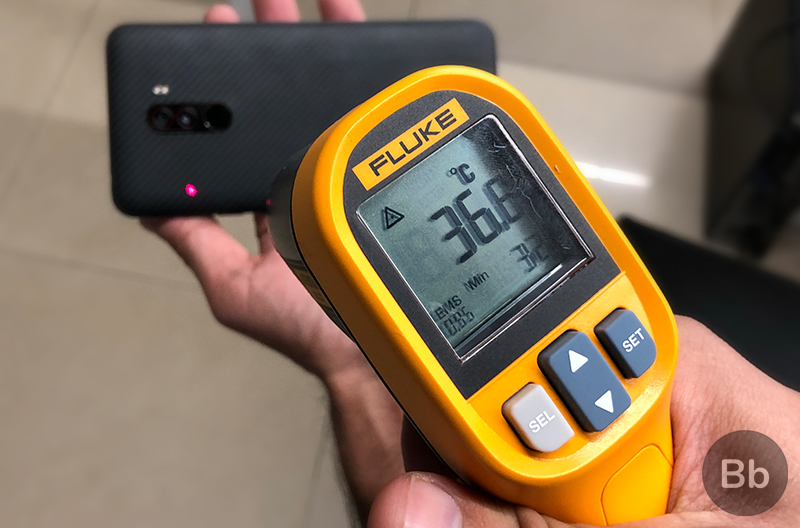
Poco F1 brings a unique suggestion in form of the liquid cooling setup that it features. Upwards until at present, the technology has by and large been express to high-operation PCs and premium smartphones including the Galaxy S and Note serial. The heat sink on the Poco F1 prevents the phone from reaching unbearable loftier temperatures and also helps it cool down pretty fast.
Different the sophisticated setup on gaming PCs, the Poco F1 uses a simple pipe which transmits the heat from the hotter to the cooler parts of the smartphone. Effectively, this results in a temperature difference of almost four°C to 8°C. You lot can read more well-nigh our test of the heat dissipation mechanism.
The Poco F1 is clearly a master performer and while it may fall slightly brusque of more expensive devices such as the OnePlus half-dozen or Asus Zenfone 5Z, this is probably because of MIUI for Poco, which still feels somewhat unfinished and is expected to improve over time. Lastly, I am really impressed by the liquid cooling machinery on the smartphone.
Speakers
One of the quirks that the Poco F1 comes with is its dual speaker setup, which is like to the Huawei P20 Pro in terms of operation. It is split between the main speaker at the bottom and a secondary speaker under the earpiece of the Poco F1. My early thoughts nigh the speakers were that the setup is very loud and clean.
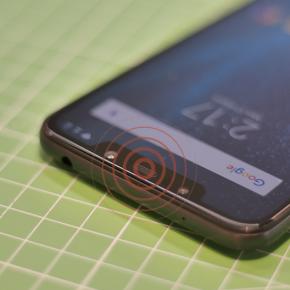
With the passage of time, I have noted that the speaker has a decent amount of clarity. While the Poco F1 challenges relatively more expensive devices, expecting the sound to match those devices will evangelize you to the harbor of thwarting. Further, the secondary speaker sounds tinny and very feeble compared to the main one.
Cameras
Poco F1 is graced by a dual camera setup, which thankfully does non protrude uncomfortably. The rear photographic camera comprises a 12-megapixel Sony sensor, which is the same equally the Mi MIX 2S and the Mi 8, and a 5-megapixel Samsung sensor which is used for sensing the depth in bokeh shots. The hardware is complemented by an AI which is capable of identifying 200 different scenes and improving the photography skills of the Poco F1.
-
Daylight
Day light shots are full of detail and have accurate colors. The same holds good when we look at pictures taken in natural lighting merely indoors. In well-lit images, in that location's sufficient item which is equated with a skilful and natural reproduction of colors.
The pictures captured by the smartphone have a punchy saturation which is achieved without whatsoever exaggeration.
-
Night & Artificial Lighting
The rear camera does a commendable job of keeping the details intact, even in a dim ambiance. The Poco F1 uses the aforementioned camera app as other Xiaomi smartphones with standard features including an AI adornment mode and a manual mode. A slight amount of noise in colour accuracy creeps in as the amount of low-cal in the frame decreases.
Information technology fares impressively well against other smartphones in its category including the Accolade Play, Mi A2, and the Nokia 7 Plus and gives a tough competition to the OnePlus 6.
-
Portrait Mode
The Poco F1 likewise features a portrait way which differentiates between background and foreground objects impeccably. The AI tin can be seen to improve the contrast of images simply some images too appear overblown.
-
Selfies
The front of the Poco F1 features a 20-megapixel sensor which, as well, picks up good details and decent exposure while taking selfies. Besides rich details and great color of selfies, the Poco F1 does exceptionally well in terms of selfie portrait and easily beats competitors in this area. The edge detection is insanely authentic, particularly in cases of bright lighting.
Lastly, you can add alive filters to the pictures while another slap-up characteristic informs you when the camera lens is dirty; however, I did non find it working very well in case of sweat smudges. You tin can take a look at our detailed camera review of the Poco F1 for better insights.
-
Video
With 4K video at 30fps and slo-mo video at upwards to 240fps, there isn't much to ask for from the Poco F1 in this price range. Videos turn out to have sufficient detail in vivid lighting and decrease with exposure. Take a look for yourself at 5:53 (I've pointed to it already):
The lack of OIS is very much felt but EIS tries its all-time to reduce the shaking of the frame. Bottomline – you still become a great video quality for the price.
Overall, the cameras on the Poco F1 are worthy of your attention and should be able to serve you lot well in nearly all lighting conditions. The dynamic colors and impeccable sharpness prompted me to click many more random pictures than I ordinarily exercise.
-
How Does The Poco F1 Camera Fare Against Competitors?
The Poco F1 is hands capable of putting its biggest competitors to shame, cheers to its great camera. In day and dark light alike, the sharpness of images remains intact and the simply trade-off is in the quality of color reproduction. I accept been fairly impressed past the camera's functioning and just wish that the AI was a chip softer with natural objects.
Here are some of the shots nosotros used for comparing:










The comparing of the camera among Poco F1, OnePlus vi, Honor Play, Mi A2, and Nokia seven Plus resulted in a neck-to-neck functioning between the get-go two of the bunch. The Honour Play had a improve photographic camera than the Mi A2 and the Nokia 7 Plus merely information technology ravaged things by overexposing the colors.





Overall, the accurate bokeh mode and profound details make me feel that Poco F1 is the best camera smartphone of the lot with the OnePlus 6 being only better in terms of capturing pare texture more elaborately.





Software
Pocophone has taken the hurting of creating a defended version of MIUI, called "MIUI for POCO", for the Poco F1 which is based on Android 8.1. This is an intermediate between the regular, loaded version of MIUI and stock Android. What seems to exist backing this conclusion is the intention of making the interface less bloated and more than fluid too offering a visually make clean interface. Being a sucker for stock Android, I prefer this version of MIUI much improve.
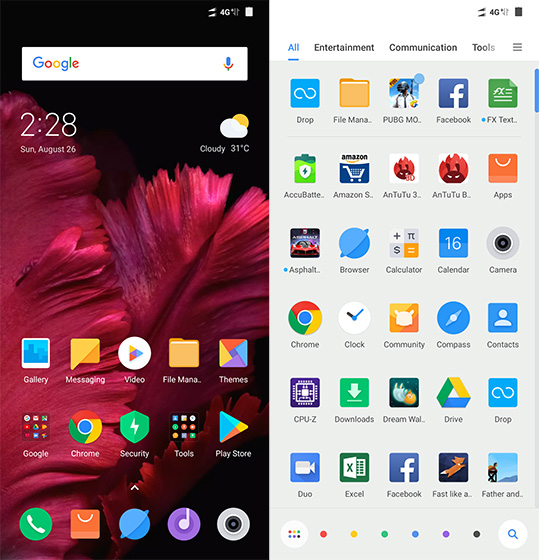
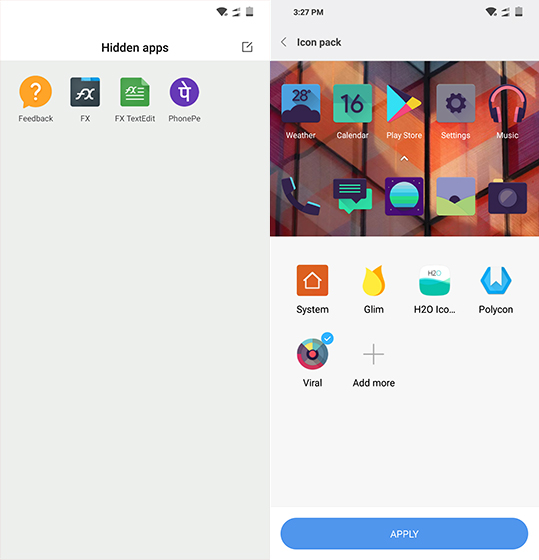
MIUI for POCO is typically MIUI with a characteristic-rich launcher which sports a cleaner notification shade and quick settings panel. Among the features, you go far the launcher is the much-needed app drawer. The launcher automatically sorts apps based on their category and also lets you sift through them based on the colour of the icons. There's likewise a search bar while you tin can as well very easily hide apps from the app drawer. You besides become a relatively minimal Settings interface – although without any alter in the available options.
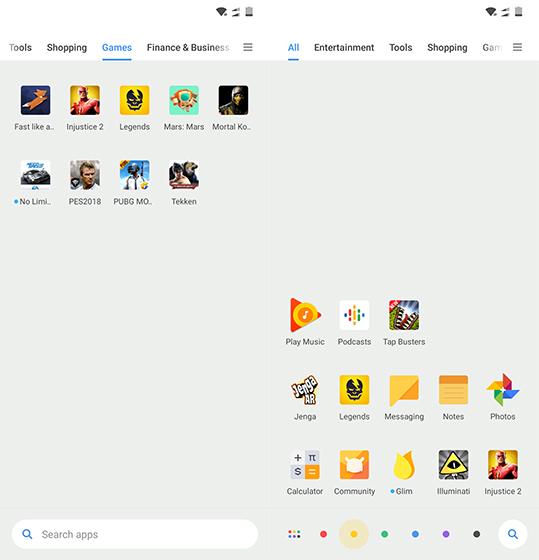
Currently, there is no manner to alter the orientation of the icons or size of the icon grid, but you go support for third-political party icon packs. At the aforementioned time, if you fancy dressing your phone with cute wallpapers and slap-up colors, in that location is back up for MIUI themes.
Equally of now, it is difficult to judge if the launcher actually enhances the functioning of the Poco F1 and but there are some issues that have been peeving me. The interface does not seem very well optimized for the big notch as y'all don't see notification badges because the available screen area is crowded by the bombardment and betoken status icons.
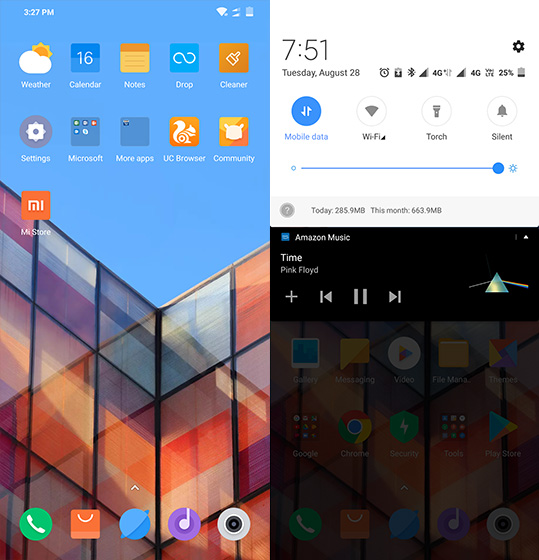
This is especially annoying when yous've to rapidly accept a glance at which apps are notifying yous instead of having to expand the notification console. Moreover, while you can too actuate elements such as network speed, icons for network and other connections button it out of the visible area.

This brings me to another peeve I have with the Poco F1 and that is, the smartphone does not allow scaling in YouTube videos – a feature present fifty-fifty on Redmi Note five Pro. So despite the wider screen, yous're express to viewing videos in their native aspect ratio and a big area of the display is wasted.
I look Pocophone to accept a look at these problems as the company has already appear a reward programme for beta testers. In terms of updates, Pocophone says that the security updates will be rolled out at least every quarter while it will strive to reduce this gap as much as possible.
The interface of the Poco F1 brings about a significant comeback in terms of smoothness past getting rid of useless animations and maintaining an overall sense of minimalism. Notwithstanding, the system could apply some improvement to make the interface more than fluid and agile. We wait these issues to exist rectified with the Android Pie update which has been promised to make it by the end of this year.
Battery
Another area where the Poco F1 outpaces its competitors is the capacity of its bombardment. The smartphone uses a 4,000mAh battery which comes with the benefit of quick charging. On heavy usage, the battery lasts for almost 16 hours with a screen-on-time of anywhere betwixt four and vi hours. On moderate usage, the smartphone tin manage to final for more than 24 hours, which is impressive.
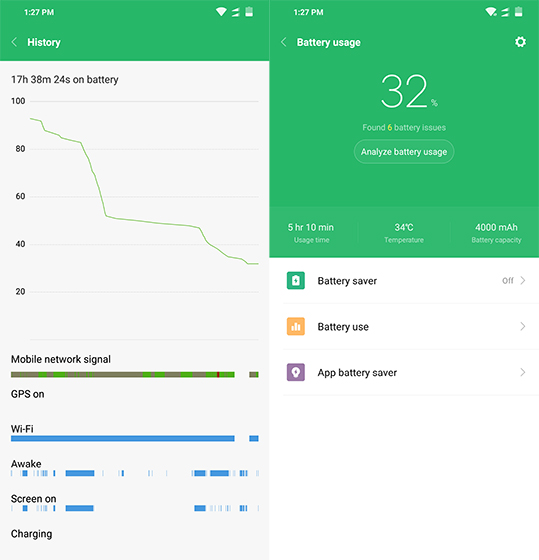
Beefing up the battery takes 120 minutes while half of the bombardment gets refueled in 50-55 minutes, thanks to Qualcomm's Quick Charge 3.0. The battery app besides features optimization options which can be used to put apps to sleep or nether restriction when they're not existence used and protection at more 90% battery capacity prevents the Poco F1 from heating.
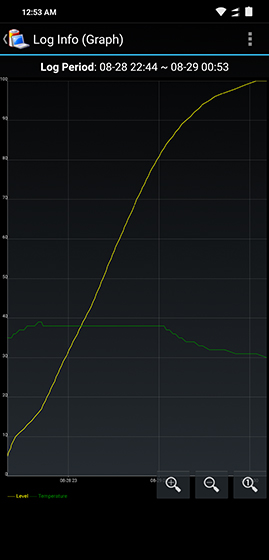
Overall, the battery performance is great but the extra chapters compared to the Honor Play and OnePlus does not actually ensure a significant bump in the battery fill-in which is something that I was expecting. Quick charging is a great addition which results in a charging fourth dimension of nigh 2 hours, which we hope to decrease with coming update.
Connectivity
On the connectivity front end, you get Bluetooth 5.0, Wi-Fi, and dual VoLTE. Pocophone has promised higher speeds and meliorate connectivity in lieu of 4G+, or 4G with MIMO (multiple-input-multiple-output), on the Poco F1. I did observebetter connectivity, especially while traveling in the Delhi Metro and in a side-by-side comparison with the Galaxy Annotation 9 and Mi A2, the Poco F1 was the first to connect to a speed test. Even so, there was just a marginal increase in the speed of the connectedness.
Further, dual 4G/VoLTE ensures that you can continue using 4G on the Poco F1 even when you're on a phone call. Lastly, the process of switching the primary SIM for information is seamless and quick.
Poco F1: A Newly Defined Flagship
The Poco F1, with its impressive specifications, is easily one of the highest values for coin. In spite of the areas in which it lags, I'm sure it can put up tough competition the OnePlus 6 and fifty-fifty other smartphones in the sub-50k range. Apart from the great performance, the Poco F1 features highly adept cameras with the goodness of AI. For the cost of Rs 20,999, information technology easily puts its prime competitors – Honor Play, Mi A2, and Nokia vii Plus – to shame. Then quirks similar liquid cooling and a striving dual speaker put information technology alee of the league.
Poco F1 is capable of bringing about a paradigm shift in our understanding of the word, "flagship".
While my experience with the Poco F1 has been tremendous and full of attractions, there are some vices which I feel could disappoint certain users. But, allow'south have annotation of the virtues of the Poco F1 before addressing its vices.
Pros
- Solid build
- Bright display
- Flagship-level functioning
- Liquid cooling
- Drool-worthy cameras
- IR face unlock
- Massive storage with micro SD support
- 4G+
- Super price-constructive
Cons
- Older gen Gorilla Drinking glass
- Tinny secondary speaker
- Poor UI optimization for rounded corners
- No defended gaming mode
Encounter ALSO: Honor Play Review: The Best Budget Phone for Gamers?
Poco F1: A Pocket-Friendly Flagship Slayer
Poco F1's major competitors, Honor Play (starts at Rs. 19,999), Nokia 7 Plus (₹25,999), and Mi A2 (Rs. xvi,999), hands bite the dust while the F1 comes out as a clearcut winner. In spite of its few drawbacks, I believe that the Poco F1 is a super powerful device which can hands pose a threat to devices such equally the OnePlus 6. I besides feel that the smartphone, if produced and sold in sufficient volumes, can bring well-nigh a alter in the manner we perceive the premium segment of electric current the smartphone marketplace. With so many reasons to make merry, the toll of the Poco F1 leaves no scope for any complaint.
And so, that'southward what we call up of the Poco F1 and we will go along to update this article every bit we feel the device fifty-fifty more. What are your thoughts? Did I miss something? Share your views in the comment department below while I render to gawking over the new flagship of the masses.
Buy the Poco F1 from Flipkart (starts at Rs twenty,990)
| REVIEW OVERVIEW | |
| Design and Build eight.5 | |
| Display 8.five | |
| Performance 9.five | |
| Gaming 9.v | |
| Speaker 8.5 | |
| Cameras 9.5 | |
| Software eight | |
| Battery nine | |
| Connectivity 9 | |
| Value for Money ten | |
| SUMMARY A skilled assassin in the cut-pharynx market, the Poco F1 truly bears the spirit of a flagship. If y'all can overlook effectively details, this tin can easily pose a threat to many expensive smartphones. With a Snapdragon 845 and stunning cameras and backed by Xiaomi'south strong supply chain, the F1 is conspicuously capable of becoming the side by side favorite among the masses. | ix OVERALL SCORE |

Source: https://beebom.com/xiaomi-poco-f1-review/
Posted by: loweryfich1995.blogspot.com
0 Response to "Xiaomi Poco F1 Review: Flagship of the Masses!"
Post a Comment